
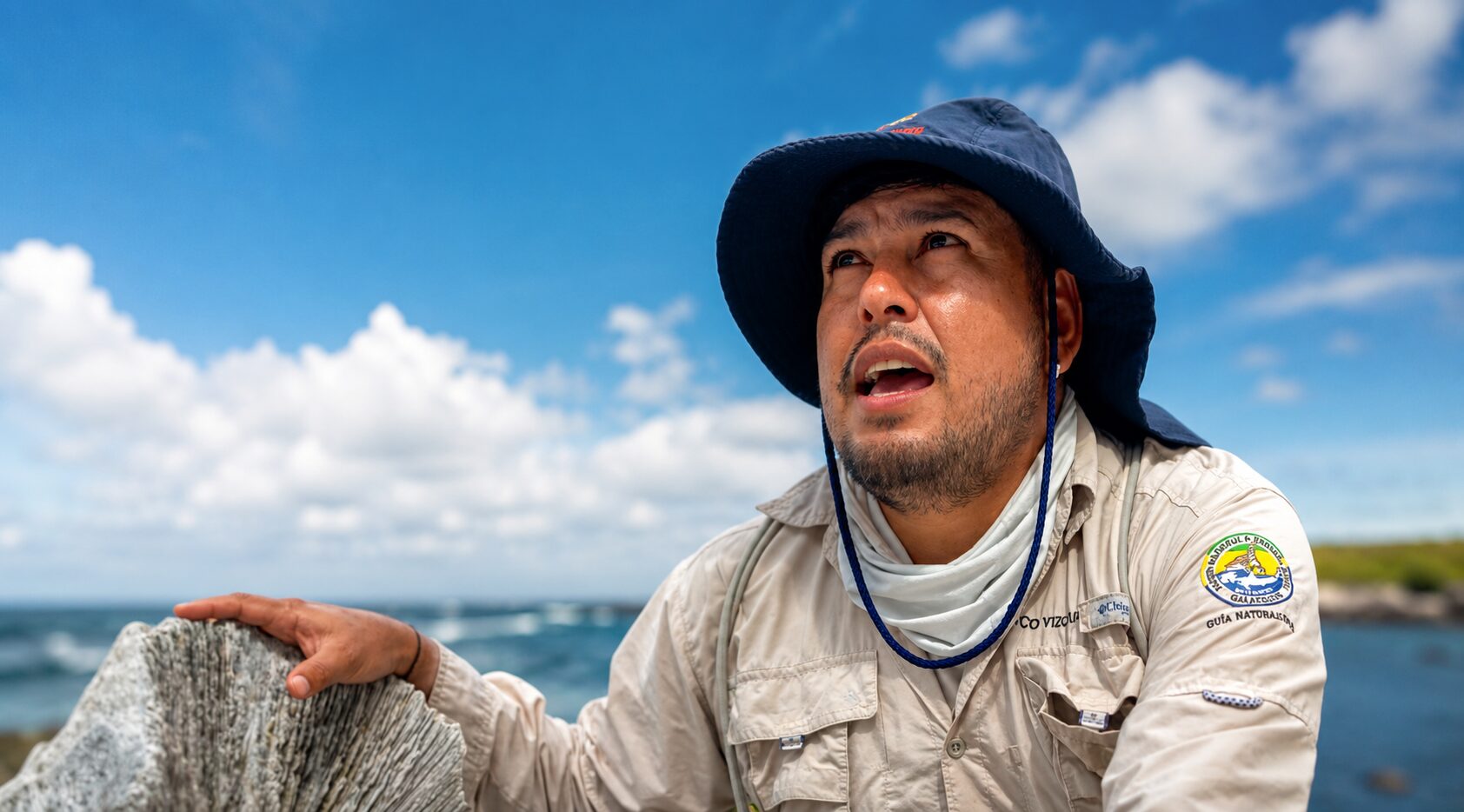
Editor’s note: this article is based on the original interview published by Mongabay (“As Galápagos ecotourism booms, top naturalist guide urges sustainability,” January 2025). All figures and direct quotes from Marco Vizcaino are drawn from that source.
Interview and reporting by journalist Erik Hoffner for Mongabay.
When a global conservation and environmental science outlet like Mongabay looks for the most qualified voice to explain what’s really happening in Galápagos, it turned to Marco Andrés Vizcaino García, certified naturalist guide and CEO of Galaapp. His account, published in January 2025, paints an honest picture of the challenges facing sustainable tourism in Galápagos: the rapid growth of ecotourism, the risk of greenwashing, and the fragility of a truly unique ecosystem.
Who Is Marco Vizcaino
Marco was born into a family of fishermen who have lived in Galápagos for generations. He discovered his passion for the islands’ ecosystem at age 15, volunteering at “La Galapaguera,” the giant tortoise breeding center. That experience led him to study Biology at ESPOL, on mainland Ecuador, on a full academic scholarship earned in 2007.
Back on the islands, he founded a travel agency focused on promoting sustainable tourism in 2013. In 2016 he was selected for the Ecuadorian government’s official guide training course and received a recognition for excellence. Today he works as an official naturalist guide based on San Cristóbal Island.
The Galápagos Ecotourism Boom, by the Numbers
According to what Vizcaino told Mongabay, Galápagos National Park and its marine reserve receive 300,000 visitors a year and sustain tourism jobs and sustainable fishing for around 30,000 residents. Tourism growth has been striking: from 240,000 visitors in 2017 to a record 329,475 in 2023.
Every visitor or group is legally required to be accompanied by a certified naturalist guide, ensuring that ecological information is shared accurately and park protection rules are followed. Vizcaino estimates there are currently around 800 active guides in Galápagos, trained in courses the government offers every 10 years, with only 140 spots per intake.
“If we truly want to protect Galápagos for future generations, we need to limit the number of tourists… the fragility of this ecosystem cannot withstand the kind of mass tourism seen elsewhere in the world,” Vizcaino warned Mongabay.
The Risk of Greenwashing in Ecotourism
One of the most critical points in the interview is Vizcaino’s warning about operators who label their tours and accommodations as “eco” without following real sustainability principles. He specifically pointed to large cruise ships carrying more than 100 passengers, whose carbon footprint and waste generation are enormous compared to small vessels or land-based options — and whose crews, in more than 90% of cases, are not local.
For Vizcaino, the key to protecting Galápagos long-term is making sure the money tourism generates stays on the islands, benefiting conservation and local livelihoods, rather than letting foreign companies end up controlling the industry.
What the Pandemic Taught Galápagos About Its Own Nature
During the total shutdown of tourism caused by COVID-19 — the first complete pause in more than 60 years of tourism on the islands — Vizcaino documented notable changes in wildlife: dolphins entering the bay of Puerto Baquerizo Moreno, flamingos nesting on Rábida Island for the first time in 20 years, and fewer abandoned eggs in the albatross colony at Punta Suárez, on Española Island.
The economic cost, however, was severe: close to 80% of the islands’ economy depends on tourism, and during the pandemic more than 70% of tourism-related income was lost. Vizcaino was out of work as a guide for more than 18 months.
The Species Galápagos Still Doesn’t Fully Understand
Vizcaino warns that while charismatic species like giant tortoises (Chelonoidis spp.) and blue-footed boobies (Sula nebouxii) draw all the attention, endemic invertebrates and many little-known plants receive far less research. He points to the pink land iguana (Conolophus marthae) as an example: only in December 2022 were hatchlings and juveniles of this poorly studied species found for the first time.
Another gap he points to is the deep-water ecosystems around the islands, still largely unexplored compared to coastal habitats like mangroves and coral reefs. Vizcaino believes a public university focused on biology and ecology is needed to close these research gaps.
Species on the Rebound — and Those Still at Risk
The eradication of invasive species like goats and rats has helped recover populations of giant tortoises and land iguanas. However, the pink land iguana remains vulnerable, with small populations and active threats.
Vizcaino expressed hope for the recovery of the Galápagos petrel (Pterodroma phaeopygia), affected by habitat destruction and the spread of invasive blackberry over its nesting grounds, as well as the Galápagos hawk (Buteo galapagoensis), a key species for the ecosystem.
Why This Matters for Your Next Trip to Galápagos
Marco Vizcaino’s interview with Mongabay confirms something we at Galaapp have believed from day one: traveling to Galápagos responsibly isn’t optional — it’s the only way these islands will continue to exist as we know them. Choosing local operators, with certified naturalist guides and low-capacity vessels, is the difference between a tour that erodes the ecosystem and one that protects it.
Discover our sustainable Galápagos cruises and check out our tours with certified naturalist guides.
He is a certified naturalist guide, born in Galápagos, and CEO of Galaapp. He was interviewed by Mongabay in January 2025 about the challenges facing ecotourism on the islands.
Under Ecuadorian law, every group of tourists must be accompanied by a certified naturalist guide, to ensure park protection rules are followed and accurate ecological information is shared.
According to figures cited by Vizcaino in the Mongabay interview, Galápagos received 240,000 tourists in 2017 and hit a record of 329,475 in 2023.
It’s the practice of operators labeling their tours or accommodations as “eco-friendly” without actually meeting sustainability standards, as is the case with some large cruise ships carrying more than 100 passengers.
Vizcaino highlights the pink land iguana (Conolophus marthae) and the Galápagos petrel (Pterodroma phaeopygia) as especially vulnerable species in need of more research and protection.
Conclusion
Marco Vizcaino’s recognition by Mongabay confirms Galaapp’s authority and commitment to tourism that protects, rather than depletes, Galápagos’ natural heritage. If you want to experience these islands alongside certified naturalist guides and operators genuinely committed to sustainability, now is the time to plan your trip with people who know Galápagos from the inside.
Original interview and reporting: Erik Hoffner, for Mongabay, “As Galápagos ecotourism booms, top naturalist guide urges sustainability” (January 2025).
